What Is Volcanic Impact on Climate (and How Does It Work)?
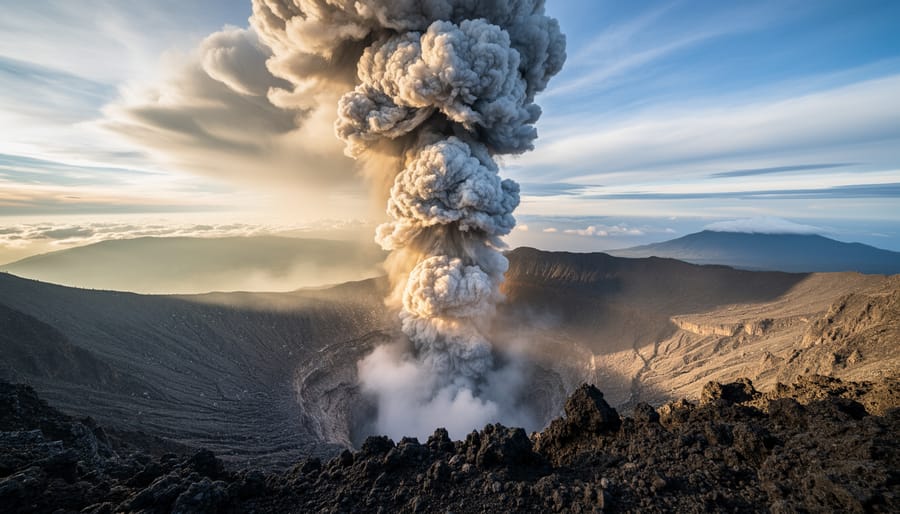
Volcanic eruptions inject massive quantities of sulfur dioxide and ash into the atmosphere, creating a reflective aerosol layer that temporarily cools the planet by blocking incoming solar radiation. This natural process can lower global temperatures by as much as 0.5°C for one to three years following a major eruption, offering scientists a vivid demonstration of how atmospheric composition directly influences Earth’s energy balance.
Understanding this cooling mechanism matters now more than ever. As climate scientists analyze temperature records and model future scenarios, distinguishing between short-term volcanic effects and persistent human-caused warming has become essential for accurate forecasting. The question isn’t whether volcanoes affect climate, they demonstrably do, but rather how their temporary influence compares to the relentless upward trajectory of greenhouse gas-driven warming.
Consider the contrast: while the 1991 Mount Pinatubo eruption cooled the planet by approximately 0.5°C within months, that cooling vanished within three years. Meanwhile, warming trends 2020 continued their decades-long climb, with 2020 tying for the hottest year on record despite no significant volcanic cooling to mask the underlying temperature increase. This stark difference reveals why volcanic activity, while scientifically fascinating, cannot offset or reverse anthropogenic climate change.
This article explains the precise mechanisms behind volcanic climate impacts, examines different eruption types and their varying atmospheric effects, and demonstrates how climate scientists separate these temporary fluctuations from long-term warming signals. You’ll discover why some eruptions cool the planet while others barely register, how researchers use volcanic events as natural experiments to refine climate models, and what recent volcanic activity tells us about the resilience of human-driven temperature trends. By grasping these distinctions, you’ll be better equipped to interpret climate data and understand the true scale of our warming challenge.
What Is Volcanic Impact on Climate?
Volcanic impact on climate refers to the temporary cooling effect that occurs when major eruptions inject gases and fine particles into the stratosphere, altering the planet’s energy balance by reflecting incoming sunlight back to space. Unlike the persistent warming caused by greenhouse gases, volcanic climate forcing typically lasts one to three years and provides a natural counterpoint that helps scientists better understand how different atmospheric changes affect global temperatures.
When a volcano erupts with sufficient force, it sends sulfur dioxide gas high into the stratosphere, where chemical reactions transform it into tiny droplets of sulfuric acid. These droplets, collectively called volcanic aerosols, spread across vast areas of the atmosphere and act as mirrors that scatter solar radiation before it reaches Earth’s surface. The result is measurable global cooling, though the magnitude depends on the eruption’s size, location, and how much sulfur-rich material reaches the stratosphere.
To understand volcanic climate effects, several key terms matter:
- Volcanic aerosols
- Tiny droplets of sulfuric acid formed when volcanic sulfur dioxide reacts with water vapor in the stratosphere, capable of persisting for months and scattering incoming sunlight.
- Stratospheric injection
- The process by which powerful eruptions propel gases and particles above the troposphere into the stratosphere, where stable air allows them to spread globally rather than washing out quickly in rain.
- Radiative forcing
- The change in Earth’s energy balance measured in watts per square meter, with volcanic aerosols creating negative forcing by reducing the amount of solar energy absorbed by the surface and lower atmosphere.
- Sulfur dioxide (SO2)
- A volcanic gas that serves as the primary source material for stratospheric aerosols, with larger eruptions releasing millions of tons that convert to reflective particles through atmospheric chemistry.
- Climate forcing agents
- Any factor that alters Earth’s energy balance, including both warming agents like carbon dioxide and cooling agents like volcanic aerosols and sulfuric acid aerosol cooling from major eruptions.
The crucial distinction between volcanic cooling and greenhouse warming lies in duration and direction. Volcanic aerosols block incoming energy and dissipate within a few years, while carbon dioxide traps outgoing heat and accumulates over decades. This means even substantial eruptions create only brief pauses in long-term warming trends driven by human activities, making volcanic events useful natural experiments rather than solutions to climate change.
How Volcanic Eruptions Affect Climate
The Aerosol Formation Process
When a volcanic eruption powerful enough to breach the tropopause occurs, it injects massive quantities of sulfur dioxide (SO₂) gas into the stratosphere, typically between 15 and 30 kilometers above Earth’s surface. This marks the beginning of a chemical transformation that shapes climate for years afterward.
Within hours to days, sulfur dioxide molecules react with water vapor and hydroxyl radicals in the stratospheric air. This oxidation process converts SO₂ into sulfuric acid (H₂SO₄), which then condenses around existing particles to form tiny sulfate aerosol droplets, each measuring roughly 0.5 micrometers in diameter. These droplets are small enough to remain suspended in the stratosphere rather than falling back to Earth.
The stratosphere’s stable layering and weak vertical mixing mean these aerosols persist far longer than particles in the lower atmosphere. While tropospheric particles typically wash out within days or weeks through precipitation, stratospheric sulfate aerosols can linger for one to three years. During this time, high-altitude winds spread them across latitudes. Eruptions near the equator, like Mount Pinatubo in 1991, distribute aerosols to both hemispheres within months. In contrast, high-latitude eruptions often confine their aerosol clouds primarily to one hemisphere.
The aerosol layer gradually thins as particles slowly settle through gravitational sedimentation and occasional stratosphere-troposphere exchange events. Particle concentration typically peaks three to six months after a major eruption, then declines exponentially. This timeline explains why volcanic cooling effects build gradually, peak within the first year, and fade over subsequent years rather than appearing and disappearing immediately.
Sunlight Reflection and Temperature Drop
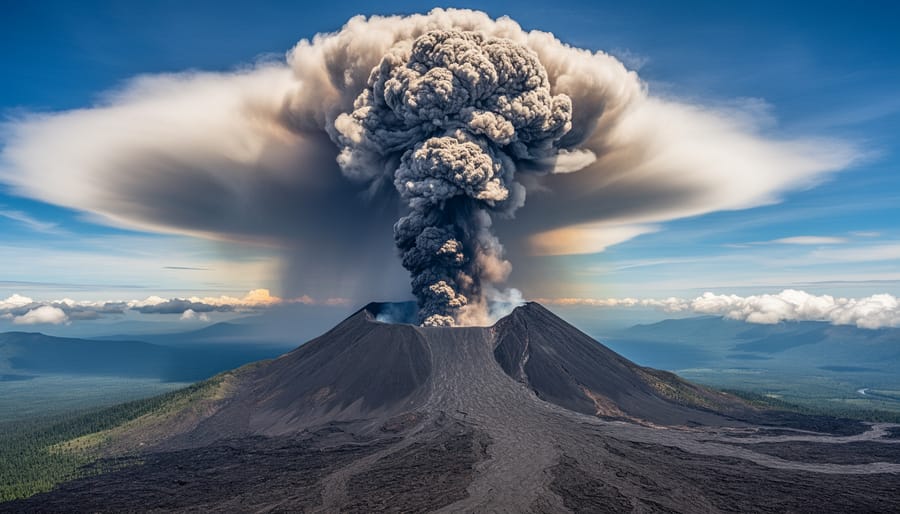
Once sulfate aerosols spread through the stratosphere, they function as tiny mirrors suspended in the atmosphere. Each particle measures roughly 0.5 to 1.0 micrometers in diameter, perfectly sized to scatter visible and near-infrared sunlight back toward space before it reaches Earth’s surface. This scattering increases the planet’s albedo, the fraction of solar radiation reflected rather than absorbed.
The cooling mechanism is straightforward: less incoming solar energy means less warming of the surface and lower atmosphere. Major eruptions can reduce incoming solar radiation by 2-4 watts per square meter globally, enough to drop average temperatures by 0.3 to 0.5 degrees Celsius. The 1991 Mount Pinatubo eruption, for instance, lowered global temperatures by approximately 0.4°C over the following year, a measurable dip that climate stations worldwide recorded.
This cooling differs fundamentally from greenhouse gas warming. While carbon dioxide traps outgoing heat, volcanic aerosols prevent incoming heat from arriving in the first place. The effect shows up quickly in temperature records, typically within months of a major eruption, and appears most dramatically in tropical and subtropical regions where solar radiation intensity is greatest.
Scientists measure these temperature drops through satellite observations of reflected sunlight, ground-based thermometer networks, and ocean heat content measurements. The consistent correlation between stratospheric aerosol density and global temperature anomalies has made volcanic eruptions valuable natural experiments for understanding Earth’s energy balance.
Duration and Geographic Spread
Volcanic climate impacts operate on a compressed but predictable timeline. The initial cooling begins within weeks after a major eruption as stratospheric aerosols form, peaks around 6 to 12 months post-event, and gradually fades as aerosols settle out of the atmosphere. Most volcanic cooling effects dissipate within 1 to 3 years, though the largest eruptions like Pinatubo maintained measurable temperature depressions for up to four years. The Pinatubo aerosol lifetime studies confirmed sulfate particles persisted in the stratosphere far longer than earlier models predicted, extending the cooling signature.
Geographic distribution patterns hinge directly on eruption latitude. Volcanoes near the equator inject aerosols into tropical stratospheric circulation, where strong meridional winds disperse particles across both hemispheres within months. Pinatubo’s 1991 eruption in the Philippines exemplifies this: sulfate aerosols circled the globe and reached polar regions within a year, creating worldwide cooling. Conversely, eruptions at higher latitudes tend to trap aerosols in their respective hemisphere. When Iceland’s Eyjafjallajökull erupted in 2010, the effects remained concentrated over the Northern Hemisphere, with minimal penetration across the equator.
The stratospheric polar vortex acts as a barrier, preventing high-latitude aerosols from crossing into the opposite hemisphere efficiently. This containment explains why Arctic or Antarctic volcanic activity rarely produces global climate signals unless the eruption is exceptionally powerful. Even mid-latitude events show asymmetric distribution, with the majority of cooling concentrated in their origin hemisphere and only secondary effects reaching the opposite half of the planet.
Types of Volcanic Climate Effects
Stratospheric vs. Tropospheric Eruptions
The altitude an eruption reaches determines whether its climate impact spreads worldwide or fades within weeks. This distinction hinges on the boundary between Earth’s two lowest atmospheric layers: the troposphere (ground to roughly 10-15 kilometers) and the stratosphere (above that threshold).
Stratospheric eruptions punch through the tropopause barrier with explosive force, injecting sulfur dioxide and ash high enough to escape the weather systems that dominate lower altitudes. Once in the stratosphere, aerosols encounter minimal turbulence and virtually no rainfall to wash them out. They drift on slow-moving currents, circling the globe over months and lingering for one to three years. Mount Pinatubo exemplified this pattern in 1991, its plume reached 35 kilometers, spreading aerosols across both hemispheres and cooling global temperatures by approximately 0.5°C for two years.
Tropospheric eruptions, by contrast, release their material into the active weather layer where rain, snow, and convection currents quickly scrub particles from the air. These eruptions might darken regional skies for days or weeks, but precipitation removes aerosols before they achieve widespread distribution. A volcano with a Volcanic Explosivity Index of 3 or lower typically stays tropospheric, producing local air quality concerns and brief temperature dips within a few hundred kilometers rather than measurable global cooling.
The practical takeaway: only explosive eruptions reaching stratospheric heights, generally VEI 4 or higher with sufficient sulfur content, generate the sustained, widespread climate effects that climate scientists track in temperature records.
Magnitude Categories and Historical Examples
The Volcanic Explosivity Index (VEI) provides a standardized scale from 0 to 8 for measuring eruption magnitude, with each step representing roughly a tenfold increase in erupted material. For climate impacts, the threshold begins around VEI 4, where eruptions inject enough sulfur dioxide into the stratosphere to create measurable global cooling.
VEI 7 eruptions produce the most dramatic climate disruptions. Mount Tambora’s 1815 eruption released approximately 60 million tons of sulfur dioxide, creating the infamous “Year Without a Summer” in 1816. Global temperatures dropped by 0.4-0.7°C, triggering widespread crop failures across Europe and North America. Snow fell in New England in June, and frost persisted through summer months in regions unaccustomed to freezing temperatures.
The 1991 Mount Pinatubo eruption, rated VEI 6, offers the best-documented modern case study. It injected 20 million tons of sulfur dioxide into the stratosphere, lowering global temperatures by approximately 0.5°C over the following two years. Satellite measurements tracked the aerosol cloud’s spread, providing invaluable data for climate models and confirming theoretical predictions about volcanic cooling mechanisms.
Smaller eruptions matter too, though their impacts remain largely regional. The 2010 Eyjafjallajökull eruption in Iceland, despite its modest VEI 4 rating and minimal climate impact, demonstrated how even moderate volcanic activity can disrupt atmospheric patterns locally. Similarly, the 2022 Hunga Tonga-Hunga Ha’apai eruption injected unusual amounts of water vapor into the stratosphere alongside aerosols, complicating its net climate effect.
These historical examples reveal a clear pattern: only the largest stratospheric eruptions create sustained global cooling, while smaller events produce temporary, localized effects that barely register against ongoing anthropogenic warming trends.
Regional vs. Global Climate Disruptions
Eruption latitude crucially determines impact spread. Tropical eruptions like Pinatubo distribute aerosols across both hemispheres via stratospheric circulation, causing global cooling. Mid-latitude eruptions, such as Iceland’s Eyjafjallajökull, remain largely confined to their hemisphere. Large tropical events alter monsoon patterns and precipitation thousands of kilometres away, while smaller high-latitude eruptions produce primarily regional effects lasting weeks rather than years.
Applications and Uses in Climate Science
Distinguishing Natural Variability from Anthropogenic Change
Volcanic eruptions serve as crucial natural experiments for climate scientists attempting to isolate human-caused warming from Earth’s inherent variability. When major eruptions temporarily cool the planet, researchers can compare observed temperature responses against climate model predictions. If models accurately reproduce the cooling magnitude and recovery timeline, this validates their sensitivity calculations for both natural aerosols and greenhouse gases.
The 2020 temperature records illustrate this distinction clearly. Despite minor volcanic activity that year, global temperatures ranked among the three warmest ever recorded. This occurred because anthropogenic warming from accumulated greenhouse gases overwhelmed any volcanic cooling. Scientists use statistical techniques called detection and attribution studies to quantify each factor’s contribution, comparing decades-long warming trends against short-lived volcanic temperature dips.
The contrast proves revealing: volcanic cooling rarely persists beyond three years, while temperature trajectories resume their upward climb as aerosols settle. Between 1991 and 2026, we observed multiple eruptions, yet each decade grew progressively warmer than the last. This pattern confirms greenhouse gas accumulation as the dominant climate forcing with volcanic events creating brief pauses rather than reversals in long-term warming.
Climate Model Validation
Volcanic eruptions function as natural laboratories for climate science, offering real-world tests that reveal whether our models accurately capture atmospheric processes. When Mount Pinatubo erupted in 1991, climate scientists had an unprecedented opportunity: they could predict the expected cooling before it occurred, then compare those forecasts against actual temperature measurements. The match between predicted and observed cooling, approximately 0.5°C global temperature drop, validated fundamental model physics and built confidence in the same radiative transfer calculations used for greenhouse gas projections.
These volcanic case studies have driven specific model improvements in several critical areas:
- Aerosol microphysics: how particles form, grow, and settle at different atmospheric levels
- Stratospheric chemistry: sulfur dioxide conversion rates and aerosol lifetime under varying conditions
- Ocean heat uptake: how the oceans buffer and delay surface temperature recovery
- Radiative transfer calculations: precise quantification of how aerosols scatter and absorb different wavelengths of light
Each discrepancy between model predictions and volcanic observations pinpoints where refinements are needed. When models underestimated the duration of cooling after the 1982 El Chichón eruption, researchers revised their aerosol removal rates. This iterative process means that the same models projecting future warming have been battle-tested against dramatic, measurable natural events, not just calibrated against gradual trends where multiple factors intermingle.
Informing Solar Geoengineering Research
Volcanic eruptions serve as unplanned experiments in stratospheric aerosol injection, offering crucial data for scientists evaluating deliberate climate intervention proposals. The 1991 Pinatubo eruption, which cooled global temperatures by approximately 0.5°C, demonstrated that sulfate aerosols can effectively reflect sunlight, but also revealed serious side effects. Researchers observed disrupted monsoon patterns, ozone depletion, and uneven cooling that disproportionately affected tropical regions.
These natural analogues help scientists model potential risks of intentional aerosol deployment, including altered precipitation patterns and unforeseen atmospheric chemistry changes. However, volcanic eruptions differ critically from proposed geoengineering: they’re one-time events rather than sustained interventions, and they emit far more particles than optimized proposals would require. Most climate scientists emphasize that studying volcanic impacts doesn’t endorse geoengineering deployment, it simply provides essential knowledge for understanding risks if humanity ever faces decisions about such controversial interventions while reducing emissions remains the primary solution.
Volcanic Activity in the Context of 2020 Global Warming
The year 2020 ranked as one of the three warmest years on instrumental record, effectively tied with 2016 and narrowly trailing behind 2019 in most global temperature datasets. This warmth occurred despite minor volcanic activity that year, demonstrating the overwhelming influence of greenhouse gas accumulation compared to natural climate forcing mechanisms.
No major stratospheric eruptions occurred in 2020 that would produce measurable global cooling. The Taal volcano in the Philippines erupted in January 2020, but its emissions remained primarily confined to the tropospheric layer and produced only localized atmospheric effects rather than widespread aerosol distribution. Similarly, smaller eruptions throughout the year lacked the explosive power and sulfur dioxide output necessary to inject significant aerosol loads into the stratosphere where they could persist and scatter incoming solar radiation.
The absence of substantial volcanic cooling in 2020 created what climate scientists call a “clean signal” year for observing anthropogenic warming. Without natural aerosol masking effects, the temperature record clearly reflected the accumulated heat from rising atmospheric carbon dioxide concentrations, which reached 412.5 parts per million that year. This makes 2020 particularly valuable for understanding how 2020 global warming proceeded without competing volcanic influences.
The contrast with previous decades proves instructive. Mount Pinatubo’s 1991 eruption temporarily suppressed global temperatures by approximately 0.5°C for roughly two years, briefly interrupting the warming trend. Yet even accounting for that temporary cooling, the long-term temperature trajectory continued upward. By 2020, global average temperatures stood roughly 1.2°C above pre-industrial baselines, demonstrating that volcanic cooling episodes create only brief interruptions in a persistent warming pattern driven by greenhouse gas emissions.
This distinction matters for climate attribution science. When researchers analyze 2020’s warmth, they can confidently attribute it to anthropogenic forcing rather than sorting through competing natural variables. The year’s temperature anomalies occurred with minimal volcanic interference, La Niña conditions that typically cool global temperatures, and reduced aerosol pollution from pandemic-related economic slowdowns, yet warmth persisted, underscoring how decisively human greenhouse gas emissions now dominate Earth’s energy balance.
Common Questions About Volcanic Climate Impact
Volcanic climate impacts often spark confusion about their role in global temperature trends. Understanding the limitations and temporary nature of volcanic cooling helps clarify why sustained climate action remains essential, even as we track the trajectory from historical warming patterns through global warming 2026 and beyond.
Can volcanic eruptions reverse global warming?
No. Volcanic cooling effects last only one to three years, while greenhouse gas warming accumulates over decades and centuries. Even the largest eruptions provide temporary temperature drops that are quickly overtaken by ongoing anthropogenic warming.
Do volcanoes emit more carbon dioxide than humans?
No. Human activities release approximately 100 times more CO2 annually than all the world’s volcanoes combined. Volcanic CO2 emissions contribute roughly 0.3 billion tons per year, while human activities generate over 35 billion tons.
Why don’t we see cooling after every eruption?
Only eruptions powerful enough to inject sulfur dioxide into the stratosphere produce measurable global cooling. Most volcanic eruptions are too small or release material only into the lower troposphere, where rain quickly removes particles before they can affect climate.
How long do volcanic climate effects persist?
Stratospheric aerosols typically remain airborne for one to three years, causing temporary cooling during this period. The largest eruptions may produce detectable temperature effects for up to five years, but the atmosphere eventually returns to pre-eruption conditions.
Another common misconception centers on whether volcanic activity has increased in recent decades. Geological records show no significant upward trend in volcanic eruptions that would explain modern warming. The dramatic temperature rise since the mid-20th century aligns instead with increasing greenhouse gas concentrations from human activities, not changes in volcanic frequency or intensity. Climate scientists account for volcanic cooling periods when analyzing long-term temperature trends, ensuring that temporary natural variations don’t obscure the persistent warming signal from fossil fuel combustion and land-use changes.
how it works
When a powerful volcanic eruption breaches the stratosphere, typically above 15 kilometers altitude, it injects massive quantities of sulfur dioxide gas alongside ash and water vapor. This sulfur dioxide becomes the key climate player. Within weeks, it undergoes a chemical transformation, combining with atmospheric moisture to form tiny sulfate aerosol particles, each roughly 0.5 micrometers in diameter.
These aerosols create a reflective veil across the stratosphere. They scatter incoming sunlight back to space before it reaches Earth’s surface, effectively reducing the planet’s energy intake. A single large eruption can lower global average temperatures by 0.3 to 0.5 degrees Celsius within months.
The cooling persists because stratospheric aerosols remain suspended for one to three years, far longer than tropospheric particles, which rain out within weeks. During this period, the aerosol cloud gradually spreads across latitudes through atmospheric circulation, widening its geographic reach.
This process operates independently of greenhouse gas concentrations. While volcanic cooling temporarily masks underlying warming trends, it doesn’t counteract the long-term heat-trapping effects of carbon dioxide accumulation. The volcanic impact fades as aerosols settle, revealing the persistent warming trend beneath.
Types or components
Volcanic climate impacts break down into several distinct components that work together to influence Earth’s temperature and weather systems.
Sulfur Dioxide Emissions form the primary cooling agent. When released during eruptions, SO₂ rises into the stratosphere where chemical reactions convert it into sulfate aerosol particles. These reflective droplets can persist for years, scattering incoming sunlight back to space.
Ash and Particulate Matter create short-term regional effects. Unlike aerosols, volcanic ash particles are heavy and settle within weeks. They primarily affect local air quality and visibility rather than global temperatures.
Volcanic Gases Beyond Sulfur include carbon dioxide and water vapor. While CO₂ emissions from eruptions add to atmospheric greenhouse gases, the quantities are negligible compared to human fossil fuel combustion, volcanic CO₂ represents less than 1% of anthropogenic emissions annually.
Ozone Layer Interactions add complexity. Volcanic particles can temporarily alter stratospheric ozone chemistry, affecting how much ultraviolet radiation reaches Earth’s surface and creating secondary climate effects beyond simple temperature changes.
Each component operates on different timescales and spatial patterns, making volcanic climate forcing a multi-faceted phenomenon.
Volcanic eruptions offer powerful natural experiments that deepen our understanding of atmospheric processes and climate sensitivity, yet their temporary cooling effects remain fundamentally different from the persistent warming driven by greenhouse gas emissions. While major eruptions can lower global temperatures by 0.3 to 0.5 degrees Celsius for one to three years, this cooling vanishes as stratospheric aerosols settle, whereas carbon dioxide from human activities accumulates for centuries.
The contrast between volcanic and anthropogenic forcing reveals a crucial distinction: nature provides brief pauses, not permanent solutions. Even the most significant eruptions of recent decades, including Mount Pinatubo in 1991, barely interrupted the upward trajectory of global temperatures. By 2020, despite minor volcanic activity that year, Earth experienced one of its warmest years on record, demonstrating that greenhouse gas concentrations dominate the climate signal.
This reality doesn’t diminish the scientific value of studying volcanic climate impacts. Each eruption refines our climate models, tests our predictive capabilities, and illuminates how aerosols interact with incoming solar radiation. These insights inform everything from short-term weather forecasting to long-term climate projections and even hypothetical geoengineering approaches.
Understanding both natural and human-driven climate forces empowers us to make informed decisions. Volcanic eruptions remind us that Earth’s climate system responds quickly to changes in energy balance, which makes our ongoing greenhouse gas emissions all the more consequential. Recognizing this distinction isn’t just academic, it’s essential for effective climate policy and meaningful action toward a sustainable future.